
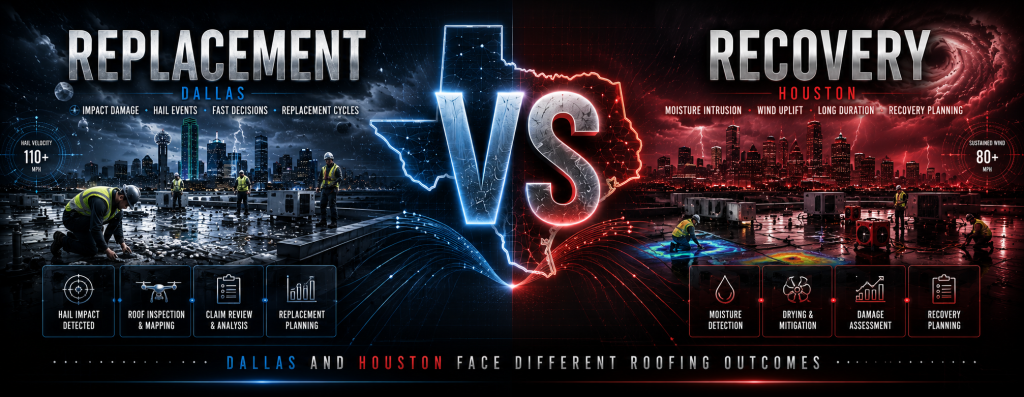

Plano vs The Woodlands Roofing — Commercial Growth And Roof Replacement Cycles
Commercial roofing systems often tell the story of regional growth.
New development creates one set of roofing challenges.
Maturing commercial districts create another.
Plano and The Woodlands represent two of the most successful suburban business environments in Texas. Both communities attract major employers, corporate campuses, healthcare facilities, retail centers, hospitality properties, and mixed-use developments.
Strong demographics support both markets.
High-value real estate exists in both markets.
Long-term growth continues in both markets.
The paths each community has followed have created noticeably different commercial roofing environments.
Understanding those differences helps property owners anticipate future replacement cycles before major failures occur.
Quarter 1: Building Age Begins Defining Roofing Decisions
Roof replacement planning often starts with one simple question.
How old is the building?
Plano experienced significant corporate growth beginning in the 1980s and accelerating through the 1990s and early 2000s.
Many commercial properties now fall within an age range where major roof replacement decisions are increasingly common.
Original systems are reaching maturity.
Second-generation systems are becoming common.
Lifecycle planning grows more important every year.
The Woodlands followed a different development pattern.
Large portions of the commercial inventory remain newer.
Master-planned growth continued steadily for decades.
Many properties still operate within earlier stages of their roofing lifecycle.
Age distribution therefore differs substantially between the two markets.
That difference influences replacement demand throughout the year.

Corporate Growth Leaves A Roofing Fingerprint
Commercial growth creates roofing inventory.
Roofing inventory eventually creates replacement demand.
Plano developed into one of the largest corporate relocation destinations in Texas.
Office campuses expanded rapidly.
Business parks multiplied.
Retail corridors followed.
Healthcare infrastructure grew alongside employment centers.
Each development wave created future replacement cycles.
The Woodlands generated similar growth through a different model.
Master-planned development produced highly coordinated commercial districts.
Corporate headquarters arrived gradually.
Healthcare campuses expanded significantly.
Hospitality and mixed-use projects followed population growth.
Development timing influences roofing demand decades later.
The replacement cycle often mirrors the original construction cycle.
Quarter 2: Spring Storm Exposure And Roof Aging
North Texas weather places Plano within one of the country’s most active hail environments.
Storm activity frequently becomes the largest driver of commercial roof replacement.
Impact damage accelerates aging.
Insurance claims influence replacement timing.
Preventative upgrades often become attractive after repeated weather exposure.
The Woodlands experiences severe weather as well.
Moisture becomes a larger factor.
Humidity remains persistent.
Heavy rainfall events occur regularly.
Wind-driven weather systems expose weaknesses around penetrations, flashing details, rooftop equipment, and drainage assemblies.
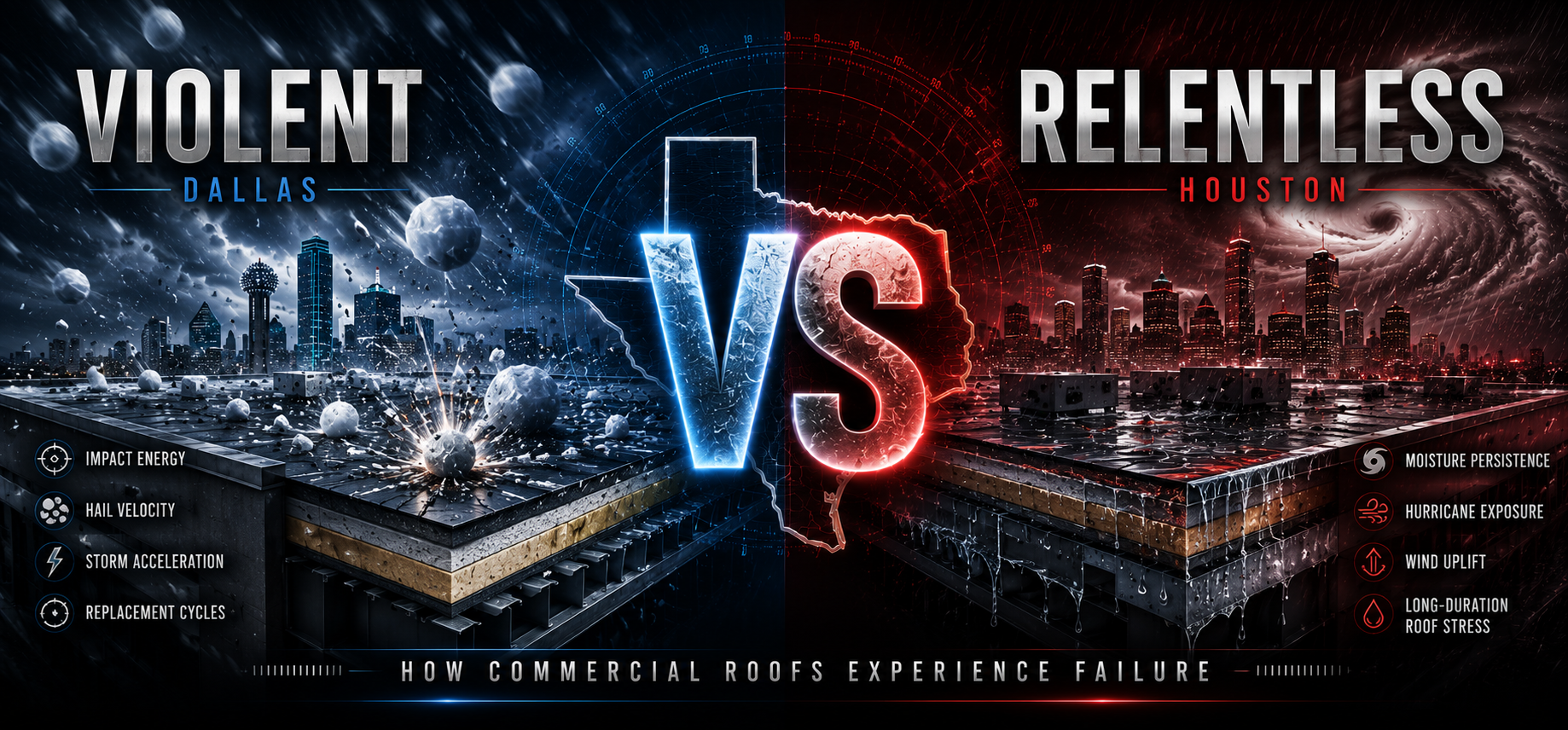
Plano roofs often fail faster because of impact.
The Woodlands roofs often deteriorate faster because of moisture.
Environmental conditions shape replacement timelines.
Growth Waves Create Future Roofing Demand
Many commercial owners focus on current building conditions.
Experienced asset managers pay attention to development history.
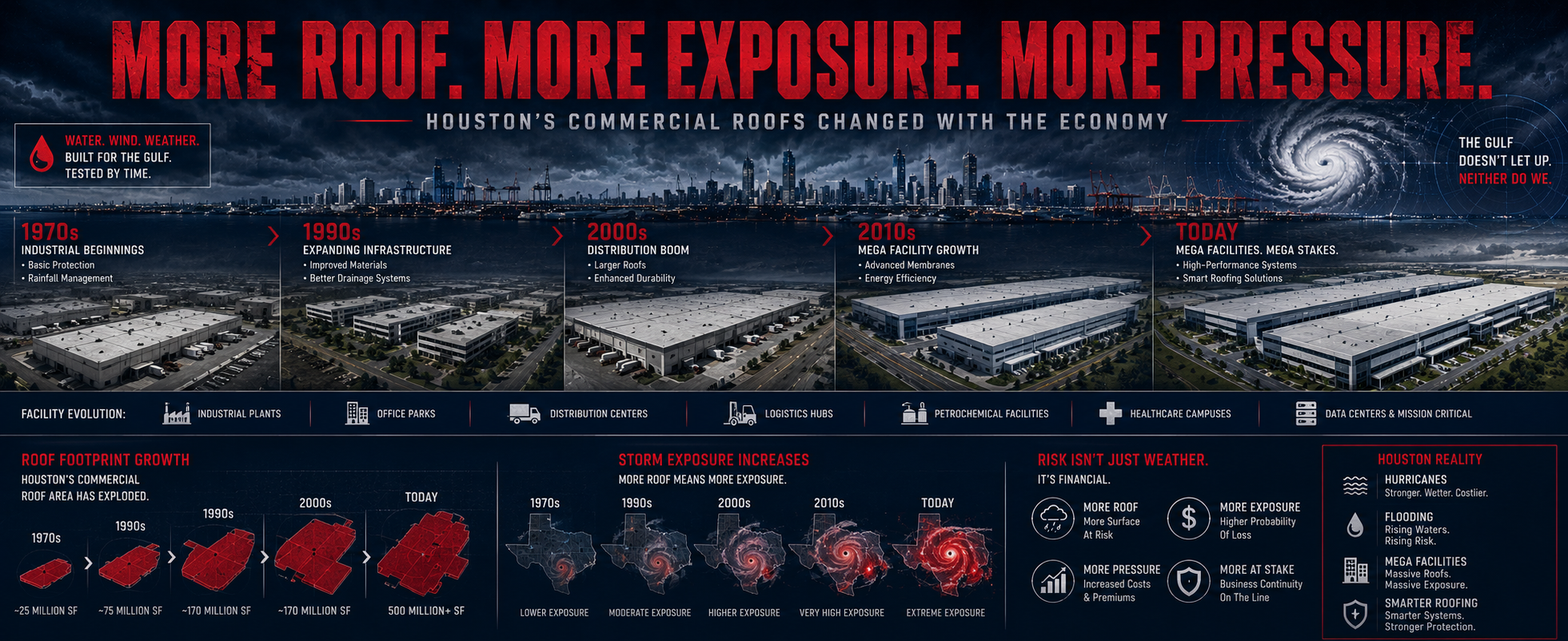
Large construction booms frequently produce concentrated replacement cycles twenty to thirty years later.
Plano now operates within portions of that cycle.
Buildings constructed during earlier expansion periods increasingly require major roofing investment.
The Woodlands remains slightly earlier within many of those lifecycle patterns.
Newer inventory shifts replacement demand further into the future.
Owners evaluating acquisitions frequently study construction dates before budgeting for capital improvements.
Roofing systems rarely fail in isolation.
Building age usually provides important clues.
Quarter 3: Summer Heat And Long-Term Roofing Performance
Summer introduces another layer of pressure.
Plano experiences intense solar exposure combined with significant thermal movement.
Roofing materials repeatedly expand and contract.
Protective surfacing degrades over time.
Mechanical stress accumulates throughout large roofing assemblies.
The Woodlands encounters similar temperatures.
Moisture changes the equation.
Humidity slows drying cycles.
Water retention remains a greater concern.
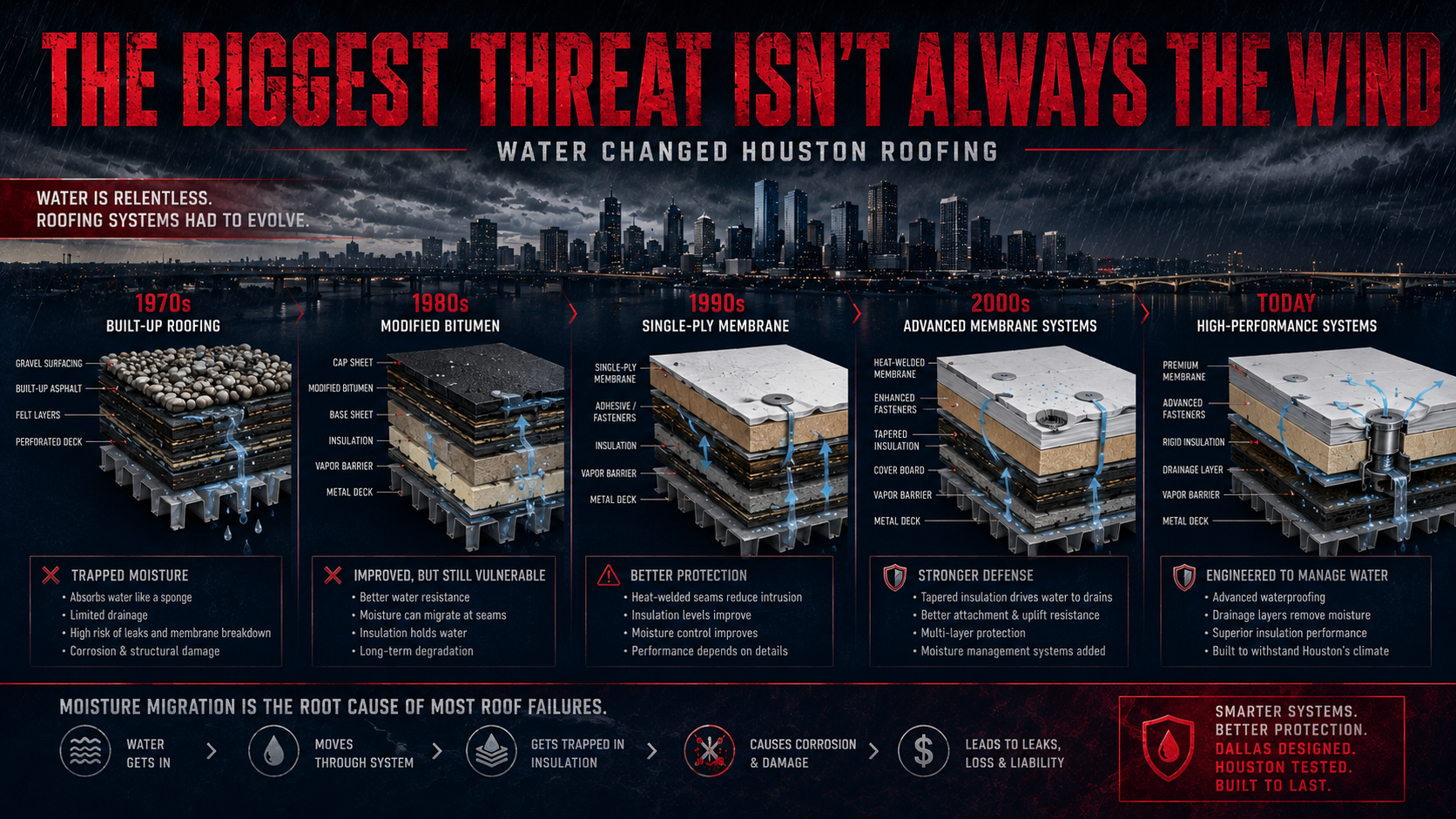
Drainage performance often becomes a major determinant of long-term roof health.
Maintenance strategies therefore diverge.
Plano owners frequently monitor storm-related deterioration.
The Woodlands owners often focus heavily on waterproofing performance.

Wealth Profiles And Capital Planning
Both communities contain substantial commercial wealth.
Investment strategies differ slightly.
Plano benefits from a concentration of corporate relocations, financial services, technology firms, and professional office users.
Capital planning frequently emphasizes asset preservation and operational continuity.
The Woodlands contains major energy-sector investment, healthcare expansion, hospitality assets, and large mixed-use developments.
Long-term ownership structures often encourage proactive replacement planning.
Deferred maintenance becomes less attractive when protecting premium commercial properties.
Building values influence roofing decisions.
High-value assets typically receive more consistent maintenance.
Those investments often extend roofing lifecycles.
Quarter 4: Replacement Planning And Budget Cycles
The fourth quarter frequently becomes budgeting season.
Property managers review inspection reports.
Ownership groups evaluate capital expenditures.
Roof replacement schedules move from planning to execution.
Plano owners often enter budget discussions following months of storm exposure.
Accumulated damage may accelerate replacement timelines.
The Woodlands owners frequently evaluate moisture-related deterioration identified throughout the year.
Waterproofing concerns often drive project prioritization.
Many organizations schedule major roofing work during periods that minimize operational disruption.
Timing becomes part of the strategy.
Execution becomes part of the investment.
Plano Versus The Woodlands: Two Growth Stories, Two Roofing Cycles
Plano commercial roofing systems reflect decades of rapid North Texas expansion combined with repeated exposure to hail, wind, and thermal movement.
The Woodlands commercial roofing systems reflect master-planned growth shaped by moisture, rainfall, humidity, and long-term environmental exposure.
Both communities continue growing.
Each market contains valuable commercial assets.
Replacement cycles remain inevitable.
Environmental conditions determine how quickly those cycles arrive.
Successful commercial roof planning begins by understanding where a property sits within its lifecycle.
Growth creates buildings.
Time creates replacement demand.
Regional conditions determine what happens in between.