
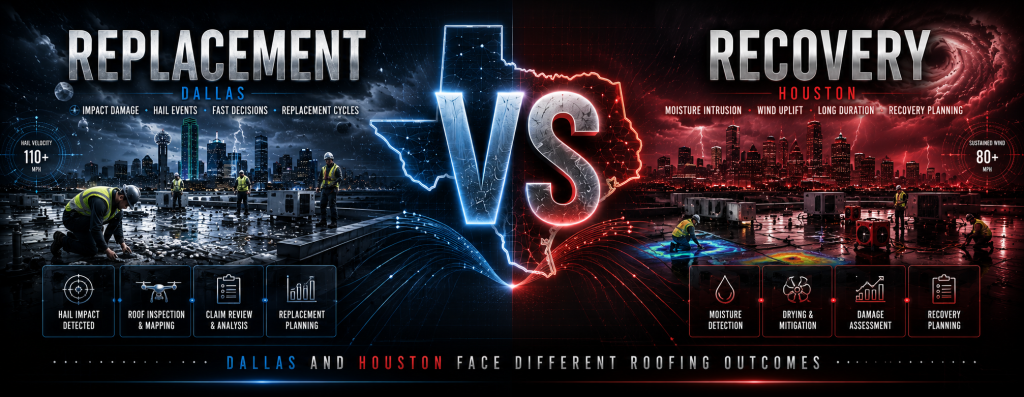

Downtown Dallas vs Downtown Houston Roofing — High-Rise Commercial Roofing Pressure
Downtown skylines create roofing challenges that rarely exist in suburban commercial corridors.
Height changes everything.
Wind behavior changes.
Access changes.
Replacement planning changes.
Inspection costs change.
Downtown Dallas and Downtown Houston both contain significant concentrations of office towers, mixed-use developments, hospitality properties, residential high-rises, and institutional buildings. Similar building types exist in each city, but the environmental pressures acting on those structures differ substantially.
Understanding those differences helps owners evaluate roof replacement decisions through the lens of local conditions rather than generic roofing assumptions.
Quarter 1: Winter Conditions And High-Rise Roofing Performance
Dallas high-rise roofs begin the year dealing with significant temperature swings.
Cold fronts move quickly across North Texas.
Warm afternoons often follow freezing mornings.
Thermal movement becomes a major factor.
Expansion and contraction place stress on flashings, rooftop penetrations, membrane transitions, and equipment curbs.
Houston experiences a different winter profile.
Humidity remains present throughout much of the season.
Moisture exposure becomes a larger concern than temperature fluctuation.
Many downtown Houston buildings spend extended periods managing condensation, damp conditions, and weather patterns that challenge waterproofing systems.
One city worries about movement.
The other worries about moisture.
Both conditions influence long-term roof performance.
Downtown Roofing Assets Are Not Typical Commercial Buildings
Most people picture warehouses when discussing commercial roofing.
Downtown districts operate differently.
Tower rooftops often support extensive mechanical systems.
Cooling infrastructure occupies a large portion of the available roof space.
Communication equipment creates additional penetrations.
Maintenance access becomes more complicated.
Replacement projects frequently require cranes, street closures, logistics planning, and coordination with neighboring properties.
Dallas continues adding modern office and mixed-use inventory throughout its urban core.
Houston contains a larger concentration of energy-sector office towers and corporate headquarters.
Building value increases significantly as structures are built higher.
Roofing failures, therefore, carry greater operational consequences.
Quarter 2: Storm Exposure And Wind Pressure Across The Skyline
Spring introduces one of the biggest differences between Dallas and Houston.
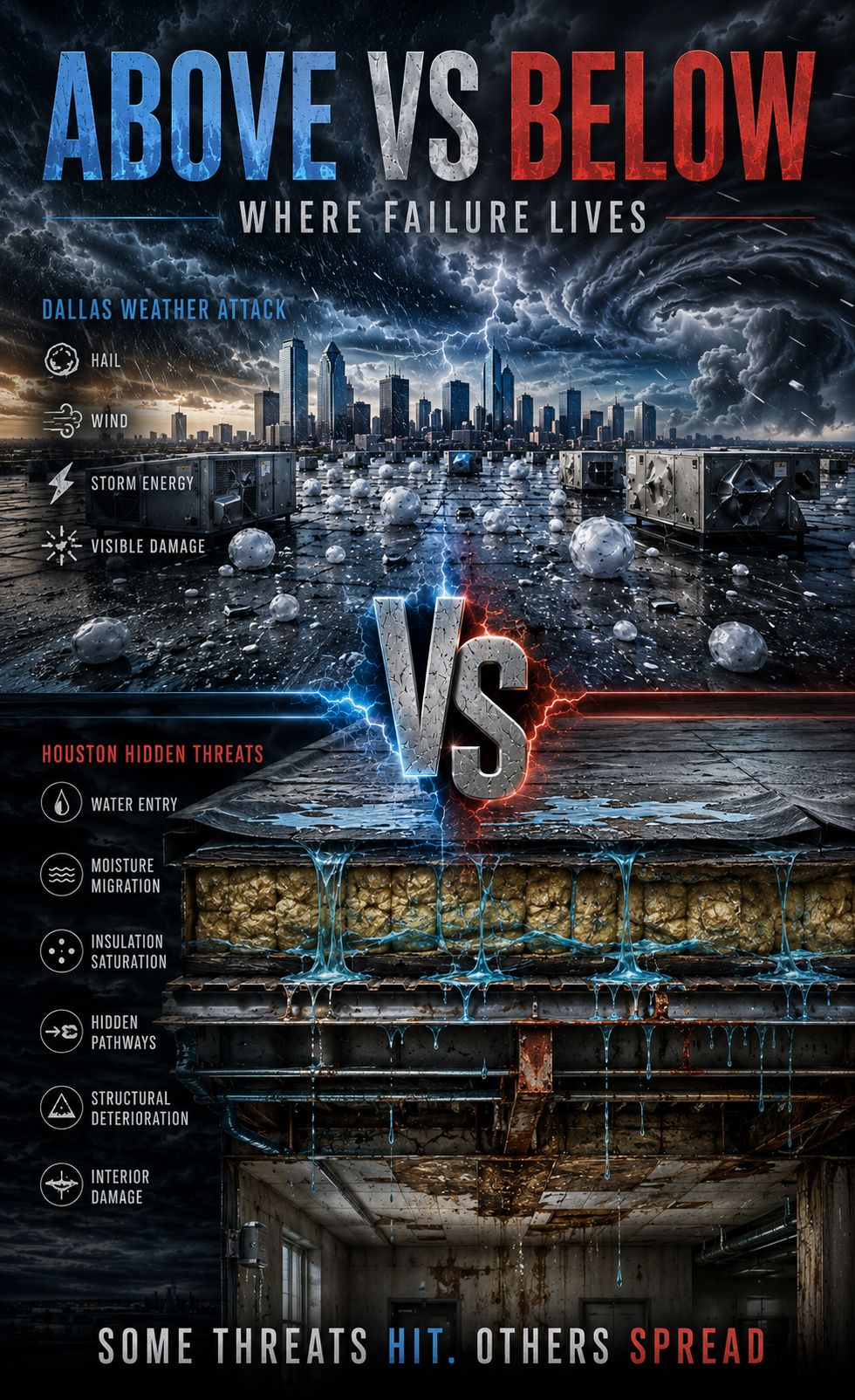
North Texas sits within one of America’s most active hail corridors.
Large storms regularly impact the region.
High-rise roofing systems face repeated exposure to hail-driven damage.
Membranes can suffer punctures.
Equipment can sustain impacts.
Protective coatings often deteriorate faster after severe weather events.
Houston faces a different threat profile.
Wind becomes increasingly important.
Storm systems moving inland from the Gulf generate uplift forces that affect taller buildings differently than lower structures.
Pressure zones increase around corners.
Roof edges experience greater stress.
Attachment systems become critically important.
Owners evaluating roof replacement projects must account for those aerodynamic realities.
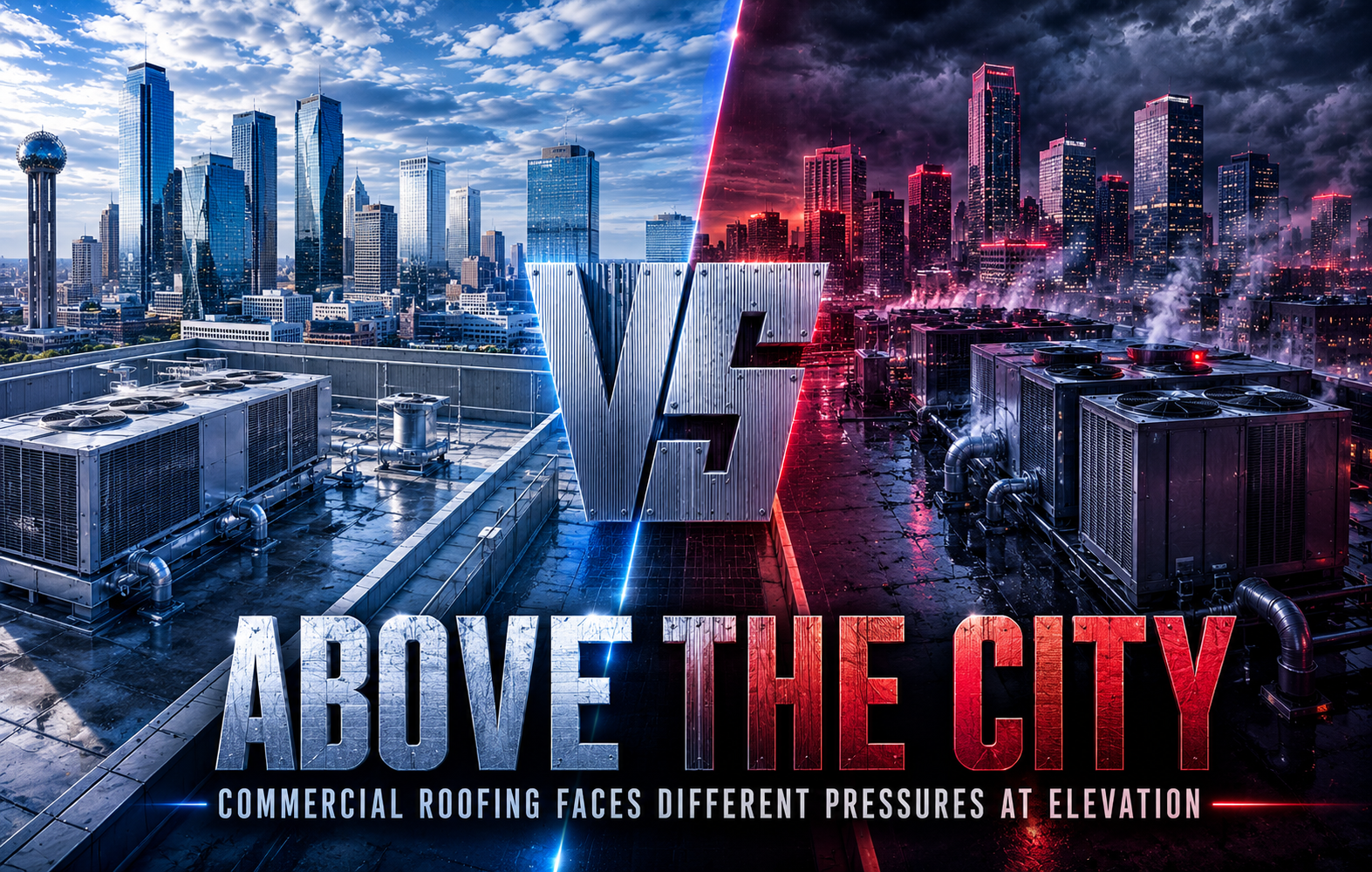
Wind Loads, Building Height, And Roofing Engineering
A twenty-story building experiences environmental forces differently than a one-story warehouse.
Airflow accelerates around vertical surfaces.
Pressure concentrates along roof perimeters.
Mechanical equipment becomes more vulnerable.
Drainage systems face greater performance demands.
Dallas engineers often focus heavily on hail resistance and severe weather durability.
Houston engineers frequently prioritize wind uplift performance and water management.
Those design priorities influence everything from membrane selection to attachment methods.
Material choices that perform exceptionally well in one city may require different specifications in the other.
Environmental conditions drive engineering decisions.
Roofing systems respond accordingly.
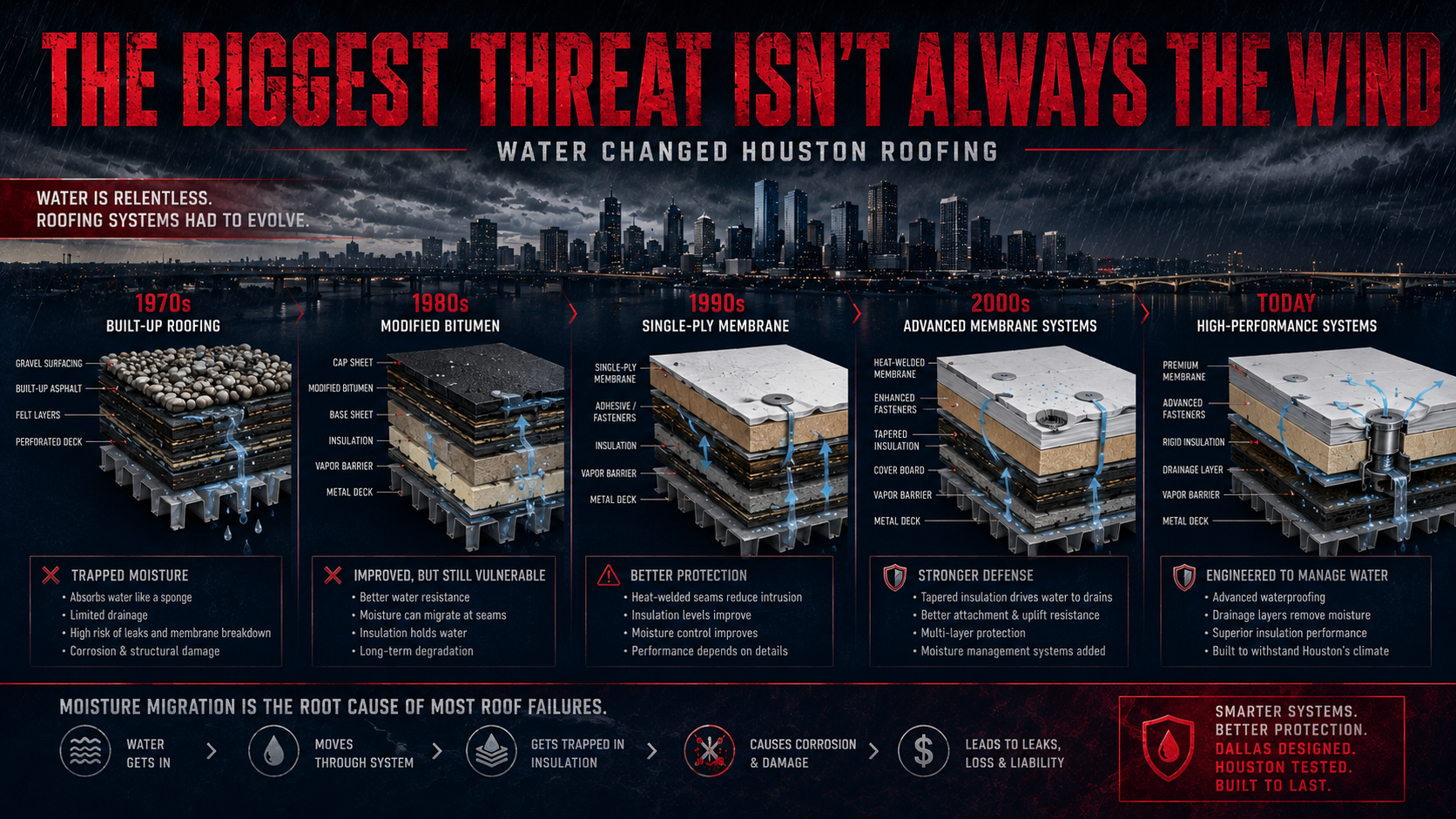
Quarter 3: Summer Heat And Rooftop Stress
Summer places extraordinary pressure on both skylines.
Dallas experiences prolonged heat combined with intense solar exposure.
Roof temperatures can rise dramatically during extended heat waves.
Thermal expansion accelerates.
Material fatigue increases.
Protective components age more rapidly.
Houston receives similar heat.
Humidity changes the outcome.
Moisture remains present throughout much of the season.
Drainage performance becomes increasingly important.
Standing water creates larger concerns.
Organic growth develops more easily.
Waterproofing failures often expand faster when moisture remains trapped within roofing assemblies.
Long-term deterioration frequently begins where heat and moisture combine.
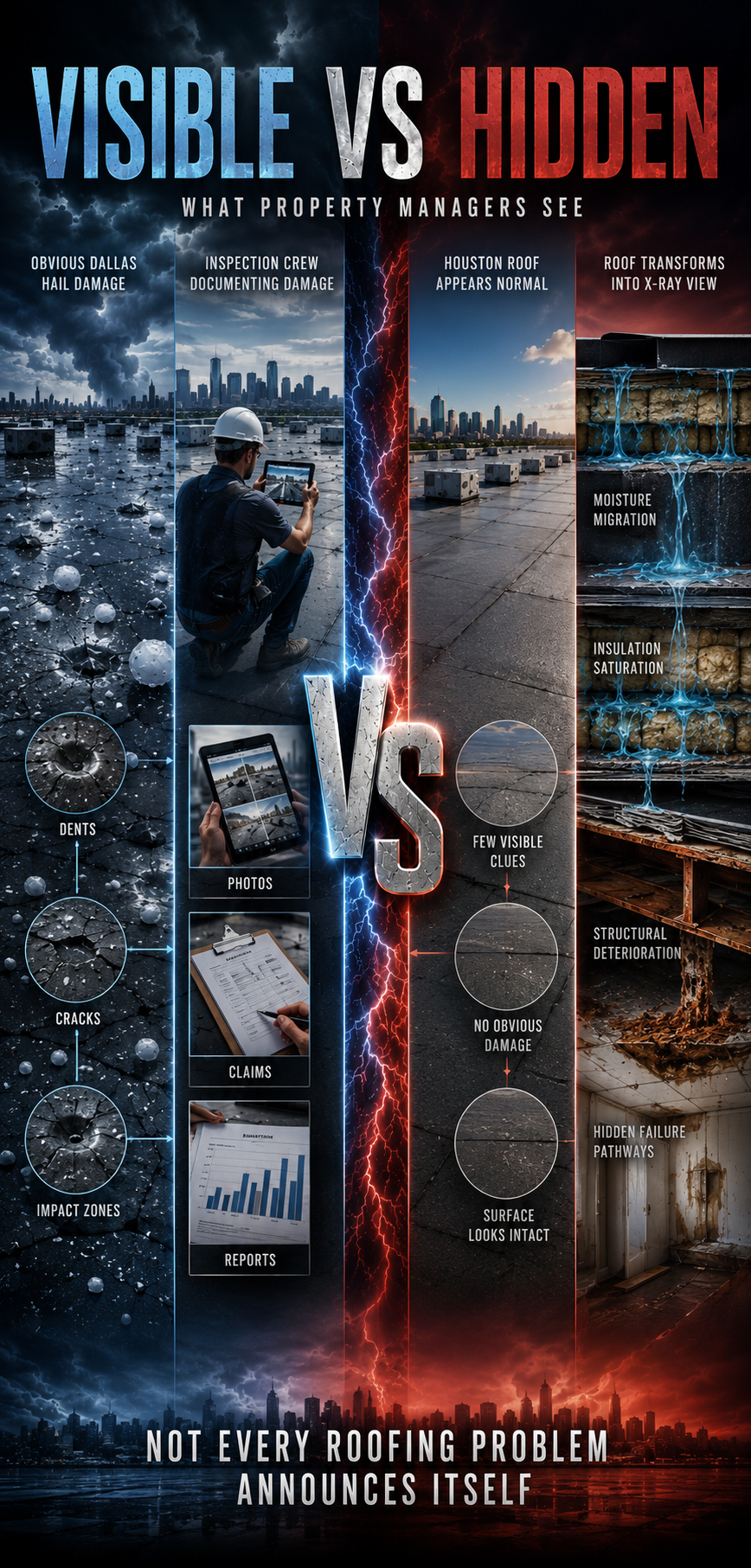
Wealth Concentration And Roof Replacement Strategy
Both downtown districts contain some of the most valuable commercial real estate in Texas.
Asset values influence roofing decisions.
Owners of premium office towers often prioritize lifecycle performance over initial installation cost.
Property managers evaluate operational disruption carefully.
Tenant expectations remain high.
Risk tolerance remains low.
Downtown Dallas continues to attract investment in finance, technology, professional services, and mixed-use development.
Downtown Houston benefits from energy, healthcare, engineering, logistics, and international commerce.
Each market contains sophisticated ownership groups.
Many replacement projects involve extensive planning rather than emergency decision-making.
Capital expenditures often reflect long-term building strategy.
Quarter 4: Hurricane Season Versus Hail Season Recovery
Fall produces another divergence between the two cities.
Dallas property owners continue monitoring severe weather and late-season storm activity.
Inspection programs frequently identify damage accumulated throughout the year.
Budget planning accelerates replacement schedules.
Houston remains closely tied to Gulf weather patterns.
Hurricane season influences decision-making far into the fourth quarter.
Wind-driven rain can expose vulnerabilities that remained hidden during previous months.
Water intrusion risks remain elevated.
Preventative replacement often becomes more attractive than reactive repair.
Building owners understand that major weather events can rapidly change roofing priorities.
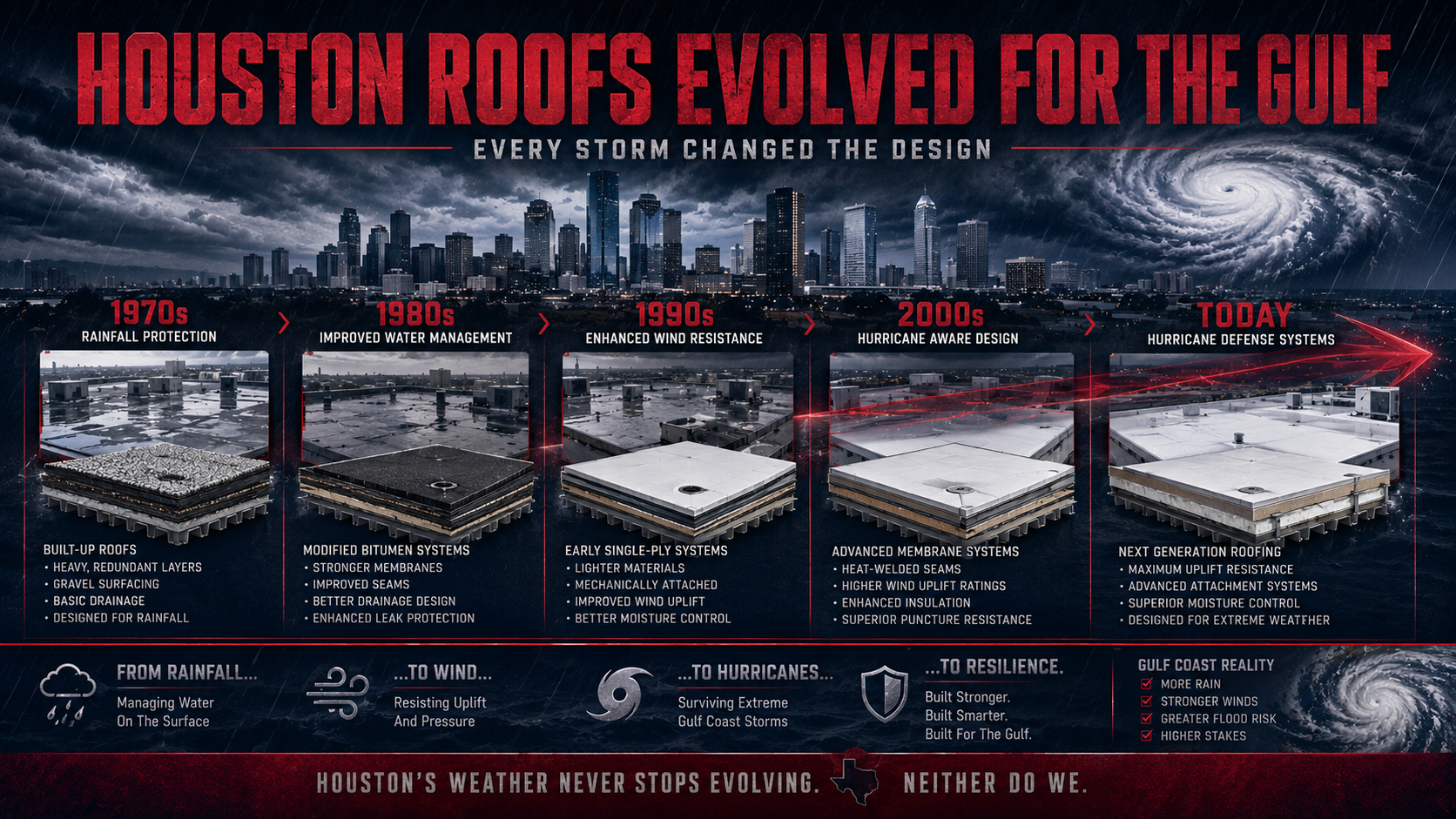
Downtown Dallas Versus Downtown Houston: Two High-Rise Roofing Environments
Dallas Downtown high-rise roofs operate in a hail-driven environment where thermal movement, severe-weather exposure, and impact resistance dominate many replacement discussions.
Houston Downtown high-rise roofs function within a moisture-driven environment where wind uplift, waterproofing performance, and hurricane preparedness receive greater attention.
The buildings may look similar from street level.
Environmental pressures tell a different story.
Successful commercial roof replacement projects begin by understanding those local realities.
A roof designed for Dallas must withstand repeated hail exposure.
A roof designed for Houston must survive years of moisture pressure and Gulf Coast weather influence.
Both cities demand sophisticated roofing systems.
Each city challenges those systems in very different ways.