
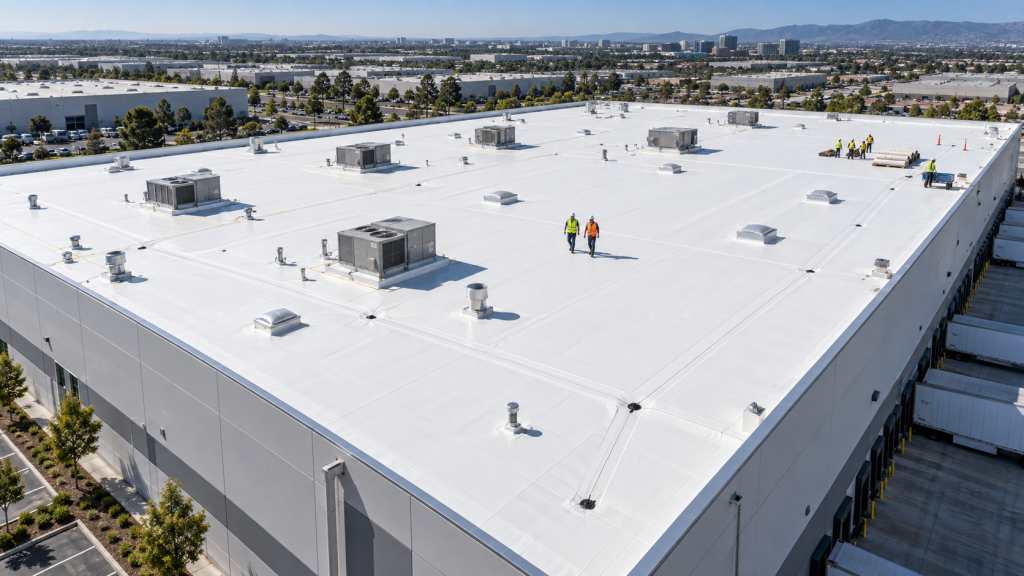
Carrollton has one of the largest concentrations of warehouse and light industrial buildings in the northern Dallas suburbs, especially along Interstate 35E and the President George Bush Turnpike. When those roofs reach the end of their life, owners usually narrow the choice to two systems: TPO single-ply membrane or a metal roof.
Both can work well. The right answer depends on the building, the existing deck and how long you plan to own it.
TPO in Brief
TPO (thermoplastic polyolefin) is a single-ply membrane, usually white, installed over insulation on a low-slope roof. Seams are heat-welded into a continuous sheet.
- Pros: lower upfront cost, reflective surface that reduces heat gain, works on most low-slope decks, good for adding insulation
- Cons: can be punctured by large hail or foot traffic, seams and flashings need regular inspection
Metal in Brief
Metal roofs for warehouses are typically standing seam or screw-down panels, often on buildings designed for them from the start.
- Pros: long service life, strong against wind, sheds water well on sloped roofs, can be coated to reflect heat
- Cons: higher upfront cost, hail can dent panels, screw-down panels need fastener maintenance, not suited to every low-slope deck
How They Compare in North Texas
Heat
A white TPO roof reflects much of the sun’s heat, which lowers cooling costs in climate-controlled warehouses. Metal can also be reflective if it has a light-colored coating. In unconditioned storage buildings, heat matters less for energy, but it still affects the life of the roof.
Hail
Neither system is hail-proof. Large hail can fracture TPO, especially over soft insulation. Metal resists punctures but dents easily, and dents can affect resale value and insurance claims. Thicker TPO membranes, higher-density cover boards and heavier-gauge metal all improve hail performance.
Lifespan and Maintenance
Well-installed metal roofs generally last longer than single-ply membranes. TPO roofs need periodic seam and flashing checks. Screw-down metal roofs need fasteners checked and replaced as washers age. Standing seam metal needs less fastener maintenance.
Cost
TPO usually costs less upfront, especially on large flat roofs. Metal costs more but may cost less over a long ownership period. If you plan to sell or refinance in a few years, the lower first cost of TPO often wins.
What About the Existing Roof?
The existing deck often decides the question. A low-slope steel deck with insulation and a membrane is a natural fit for TPO. An existing metal roof in fair condition may be a candidate for a coating or a retrofit system instead of full replacement. In some cases, a new TPO roof can be installed over an existing metal roof with a retrofit insulation system.
Questions to Ask Before You Choose
- How long do we plan to own the building?
- Is the warehouse climate-controlled?
- What is the existing deck and roof slope?
- How much rooftop equipment and foot traffic does the roof see?
- What warranty comes with each option, and what does it cover?
Warehouse Roofing in Carrollton
We install TPO, metal and coating systems on warehouses across Carrollton, Dallas and Irving. Call 866 865 2560 for an inspection and a written comparison for your building.