
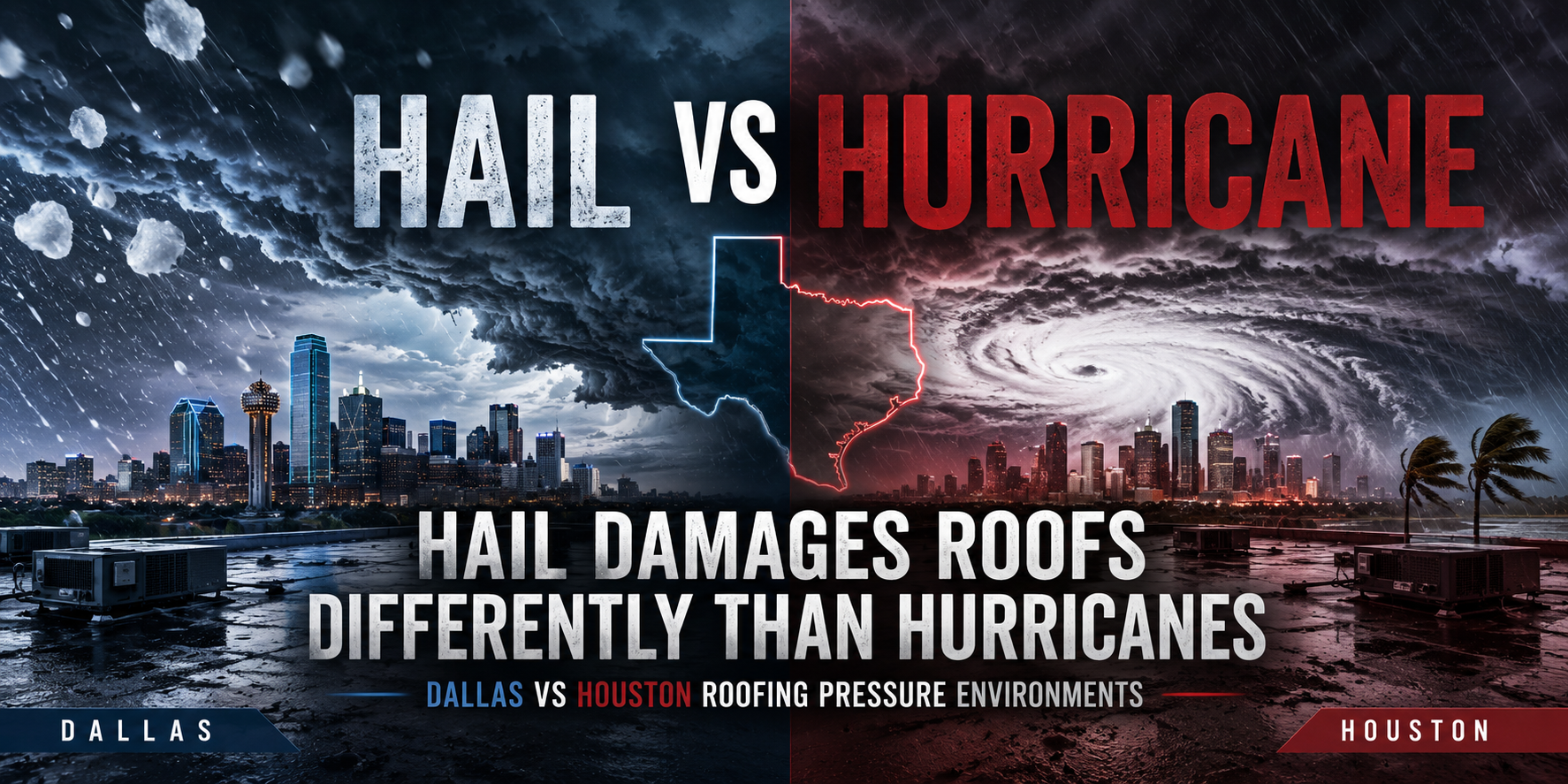
Dallas vs Houston — Hail Exposure vs Hurricane Roofing Pressure
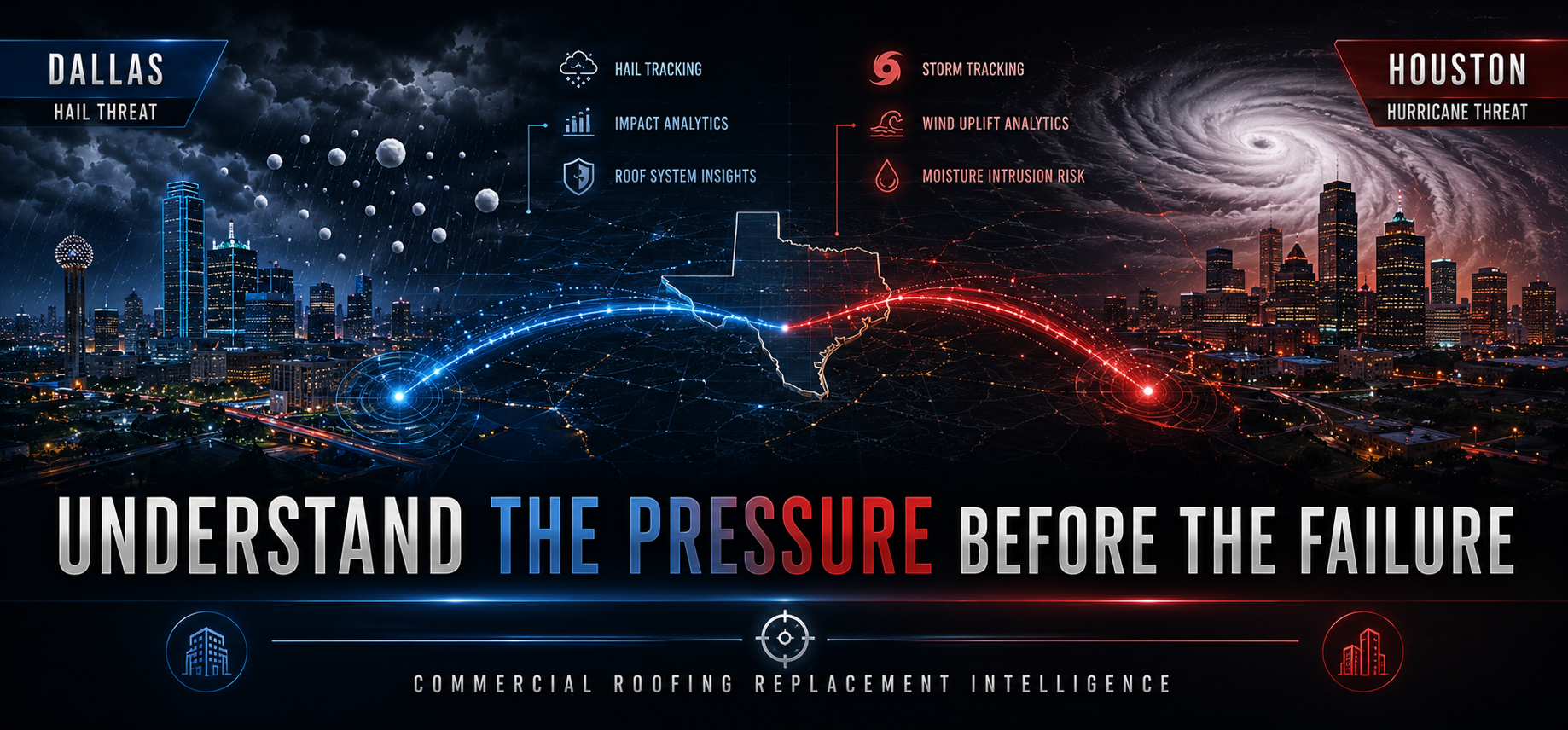
Commercial roofing systems across Texas face significant environmental stress. The source of that stress changes dramatically between Dallas and Houston.
North Texas experiences some of the most active hail conditions in the United States. Gulf Coast properties operate under a completely different set of pressures driven by hurricanes, moisture exposure, wind uplift, and long-duration weather events.
Property owners evaluating roof replacement projects often discover that roofing decisions successful in one city may perform very differently in the other.
Understanding those differences helps building owners make better long-term roofing investments.
- Downtown Dallas vs Downtown Houston Roofing — High-Rise Commercial Roofing Pressure
- North Dallas vs West Houston Roofing — Corporate Campus Roofing Systems
- Plano vs The Woodlands Roofing — Commercial Growth And Roof Replacement Cycles
- Frisco vs Katy Roofing — Rapid Expansion Commercial Roofing
- Irving vs Energy Corridor Roofing — Office Campus Roofing Environments
- South Dallas vs East Houston Roofing — Industrial Roofing Replacement Pressure
- Fort Worth Logistics Corridor vs Southeast Houston Roofing — Warehouse Roofing At Scale
- Richardson vs Sugar Land Roofing — Technology Districts And Commercial Roof Aging
- Arlington vs Texas Medical Center Roofing — Institutional Roofing Exposure
- North Fort Worth vs Northwest Houston Roofing — Distribution Center Roofing Expansion
Quarter 1: Winter Roofing Conditions And Environmental Stress
Dallas enters the year with large temperature swings. Cold fronts move through quickly. Thermal movement begins early as roofing materials expand during warm afternoons and contract during colder nights.
Repeated cycling creates stress on fasteners, seams, flashing systems, and rooftop penetrations.
Houston experiences a different challenge.
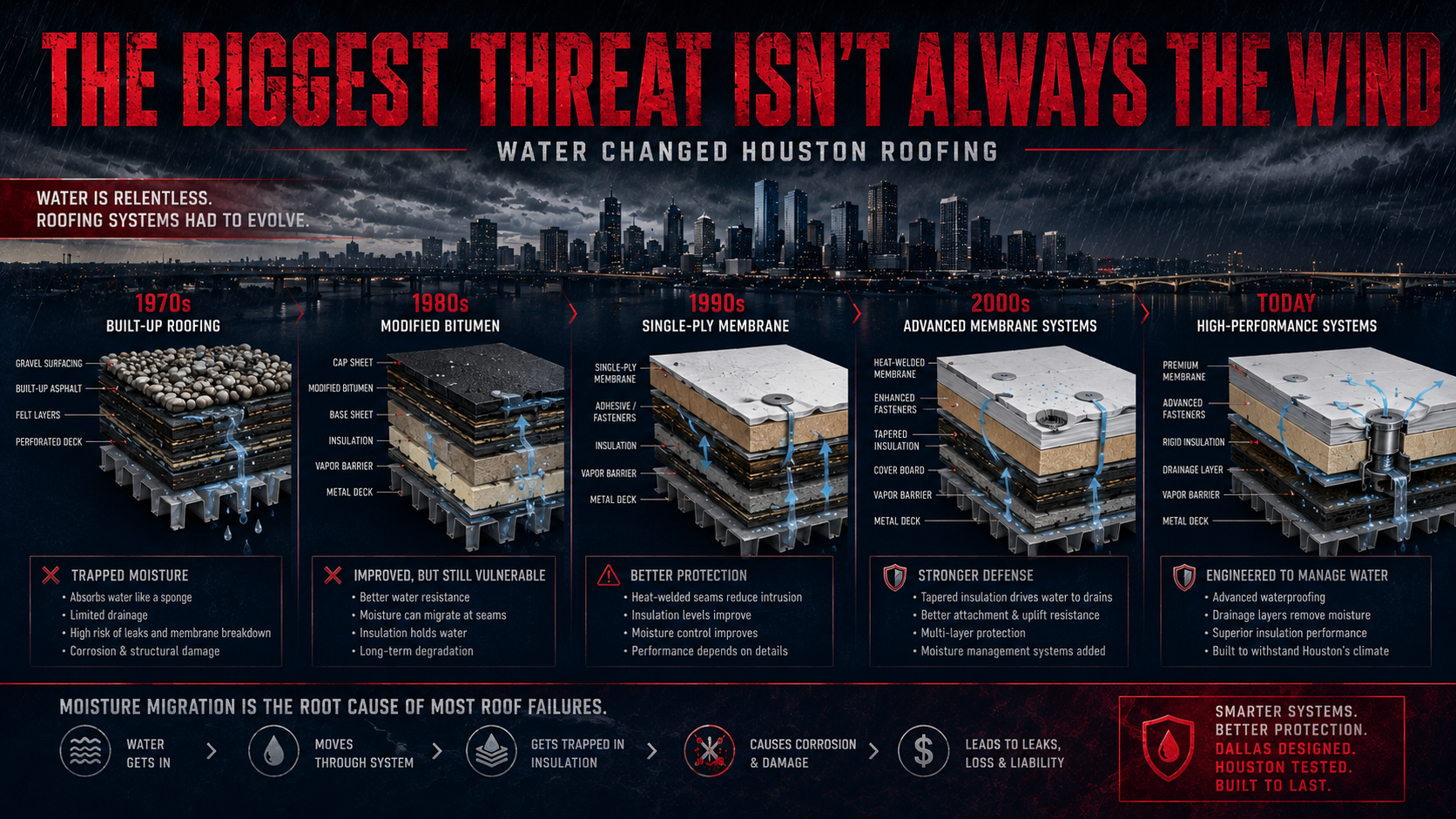
Moisture remains a year-round factor. Humidity levels stay elevated even during winter months. Roofing assemblies often spend longer periods exposed to damp conditions that can accelerate deterioration around vulnerable details.
Many Dallas property owners focus on thermal durability.
Many Houston owners focus on moisture resistance.
Those priorities shape replacement decisions long before severe weather season begins.
Commercial Roofing Assets Across Two Different Texas Economies
Dallas contains one of the largest concentrations of logistics, warehouse, distribution, office, and industrial facilities in the country.
Massive fulfillment centers continue expanding throughout the metro area.
Large flat-roof systems dominate many commercial corridors.
Houston’s economy creates a different roofing landscape.
Energy facilities, petrochemical operations, healthcare campuses, manufacturing centers, and port-related infrastructure play a larger role throughout the region.
Many facilities operate continuously and place high value on risk reduction during replacement projects.
Downtime often carries substantial operational consequences.
Roof replacement planning therefore becomes closely tied to business continuity strategies.
Quarter 2: Spring Storm Season And Roofing Risk
Spring begins separating Dallas and Houston even further.
Severe thunderstorms regularly develop across North Texas.
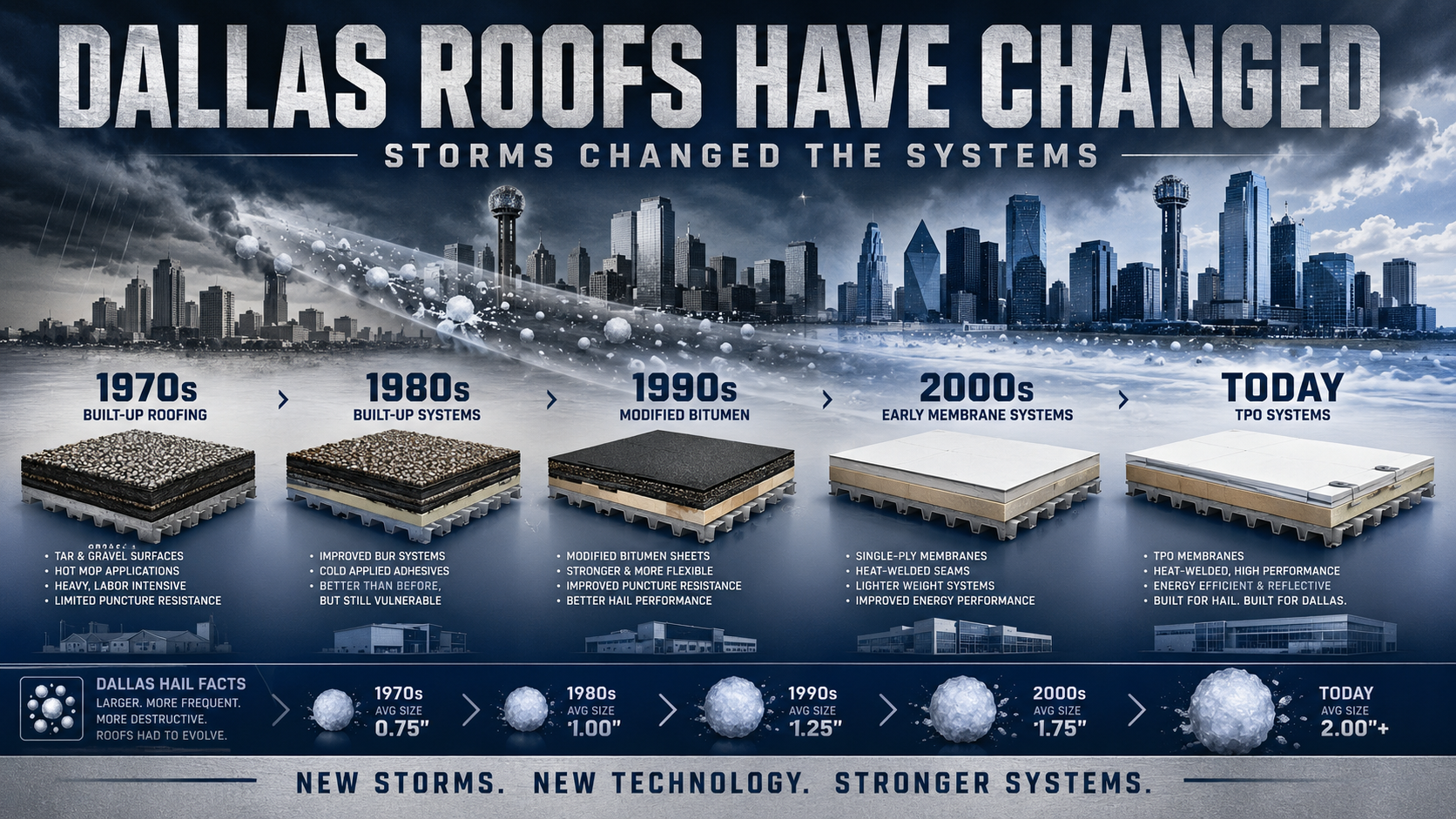
Large hail becomes one of the primary drivers of commercial roof replacement demand.
Impact damage can affect membranes, insulation systems, rooftop equipment, skylights, metal panels, and drainage components.
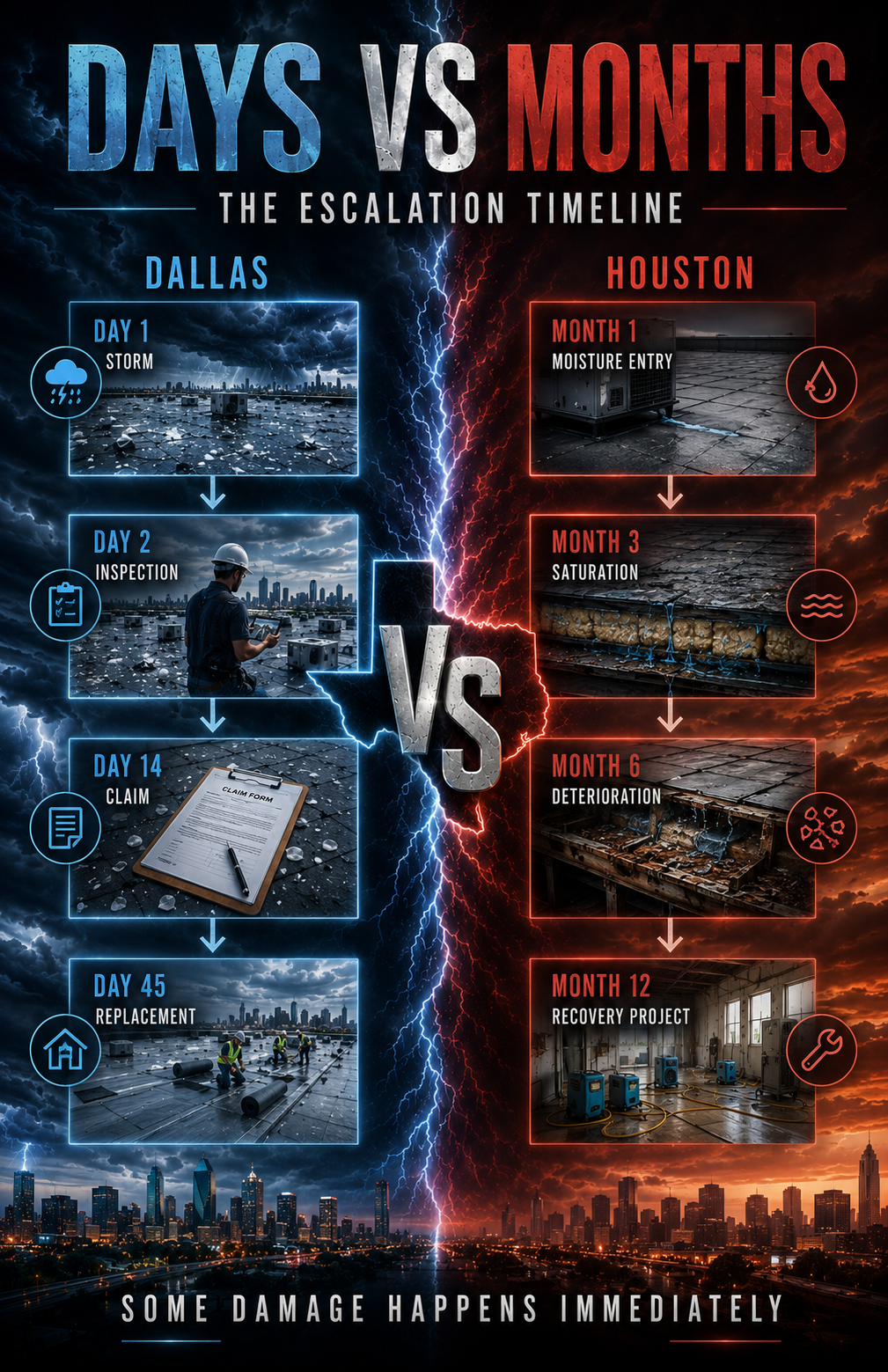
Insurance claims frequently follow major hail events.
Roofing contractors often mobilize rapidly after significant storms move through the region.
Houston sees severe weather as well.
Wind-driven rain becomes increasingly important.
Moisture intrusion pathways frequently develop around rooftop penetrations, flashing systems, mechanical equipment, and aging waterproofing assemblies.
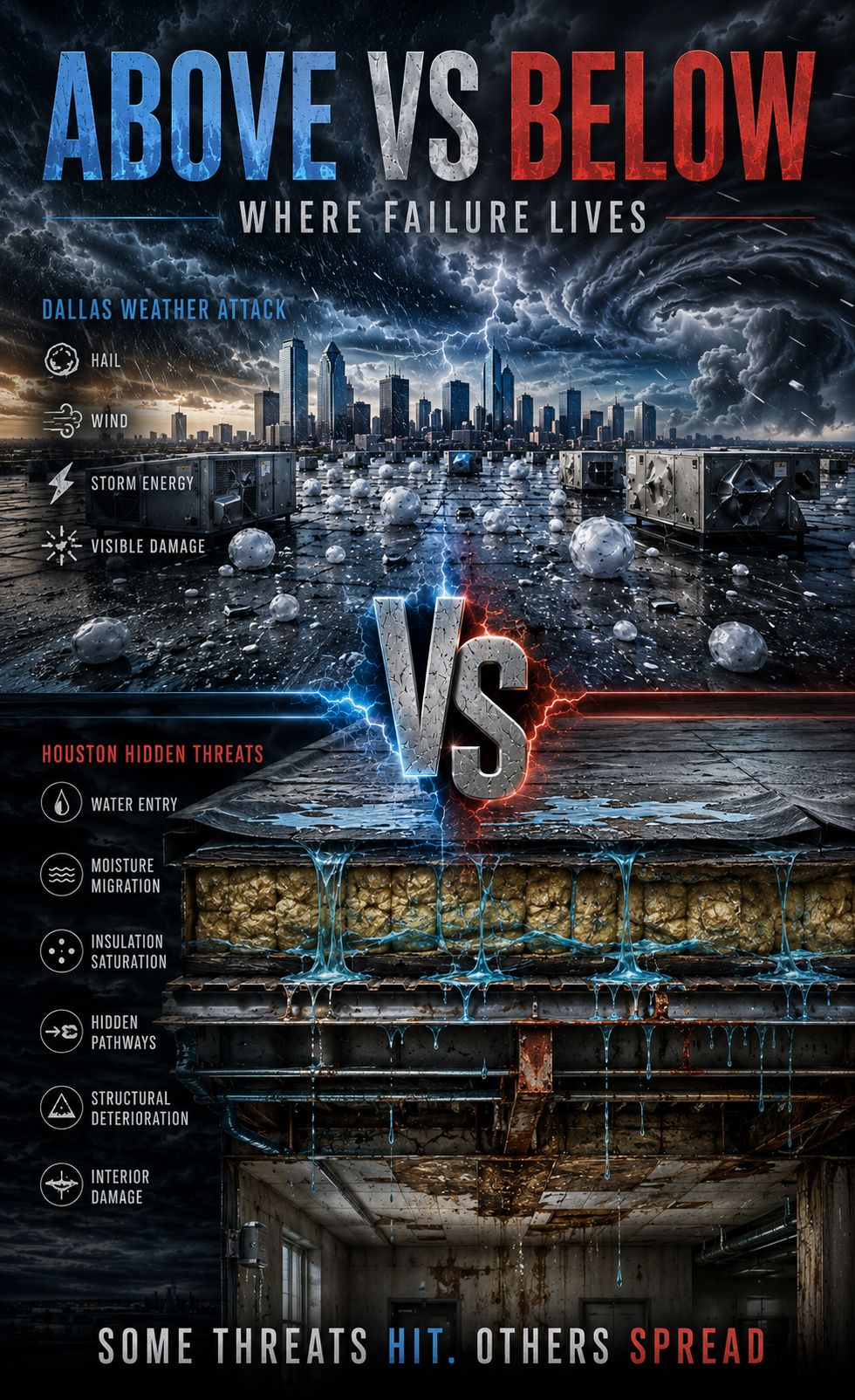
Hail may create localized damage.
Extended storm exposure often creates broader building-envelope concerns.
Hail Damage Versus Hurricane Preparation
A Dallas roofing strategy frequently centers around impact resistance.
Building owners evaluate how roofing assemblies perform when struck by hail traveling at high velocity.
Material selection often focuses on durability and replacement-cycle performance.
Houston places greater emphasis on wind performance.
Hurricane-force conditions introduce uplift pressures that can challenge roofing systems across large commercial structures.
Edge securement becomes critical.
Attachment methods become critical.
Perimeter details become critical.
Failure at one location can allow wind forces to expand damage across much larger roof areas.
Those risks influence engineering decisions throughout the Gulf Coast region.
Quarter 3: Summer Heat And Roof Aging
Summer temperatures create challenges in both cities.
Dallas commonly experiences prolonged heat waves combined with intense solar exposure.
Roof surfaces may reach temperatures far above ambient air conditions.
Expansion and contraction continue accelerating material fatigue.
Houston receives similar heat.
Humidity changes the equation.
Moisture retention often increases thermal stress within roofing assemblies.
Organic growth can develop more easily.
Drainage performance becomes increasingly important.
Water that remains trapped on roofing surfaces accelerates deterioration and shortens system life expectancy.
Owners managing older assets frequently prioritize drainage upgrades during replacement projects.
- Downtown Dallas vs Downtown Houston Roofing — High-Rise Commercial Roofing Pressure
- North Dallas vs West Houston Roofing — Corporate Campus Roofing Systems
- Plano vs The Woodlands Roofing — Commercial Growth And Roof Replacement Cycles
- Frisco vs Katy Roofing — Rapid Expansion Commercial Roofing
- Irving vs Energy Corridor Roofing — Office Campus Roofing Environments
- South Dallas vs East Houston Roofing — Industrial Roofing Replacement Pressure
- Fort Worth Logistics Corridor vs Southeast Houston Roofing — Warehouse Roofing At Scale
- Richardson vs Sugar Land Roofing — Technology Districts And Commercial Roof Aging
- Arlington vs Texas Medical Center Roofing — Institutional Roofing Exposure
- North Fort Worth vs Northwest Houston Roofing — Distribution Center Roofing Expansion

Commercial Roofing Wealth Profiles And Replacement Decisions
Dallas contains numerous rapidly developing commercial districts where newer facilities dominate the landscape.
Growth encourages proactive replacement planning.
Many owners view roofing systems as part of broader asset-management strategies.
Houston contains significant concentrations of high-value industrial and energy-related infrastructure.
Capital planning frequently focuses on resilience.
Facility managers often evaluate replacement projects through the lens of operational continuity rather than appearance alone.
Financial priorities differ.
Environmental threats differ.
Building portfolios differ.
Those differences produce noticeably different roofing decision-making processes.
Quarter 4: Fall Weather, Hurricane Season And Capital Planning
Dallas enters the final quarter with continued exposure to severe weather events and occasional hail activity.
Budget planning often shifts toward replacement projects identified after spring and summer inspections.
Houston remains focused on tropical weather until hurricane season subsides.
Late-season storms continue creating uncertainty for commercial property owners throughout the Gulf Coast.
Wind-driven rain events can expose vulnerabilities that remained hidden throughout much of the year.
Inspection activity typically increases as owners prepare for the following year.
Replacement schedules often accelerate once hurricane threats diminish.
Dallas Versus Houston: Two Roofing Markets Built Around Different Threats
Dallas commercial roofing systems operate within a hail-driven environment where impact resistance, thermal movement, and storm recovery frequently dominate replacement conversations.
Houston commercial roofing systems operate within a hurricane-driven environment where wind uplift, moisture management, and long-duration weather resilience often receive greater attention.
Neither market faces a simple roofing problem.
Each city presents a distinct environmental challenge.
Successful roof replacement projects begin by understanding those local conditions.
The buildings may share the same state.
The roofing risks tell a very different story.